



Boat owners looking to get their vessel federally recognized must understand the steps for vessel documentation. A legal process establishing a vessel’s nationality, ownership, and eligibility for uses. Although it may look like a complicated process, ordering your thoughts is a straightforward process that guarantees accuracy.
Often times, owners bond during acquisition, financing or transition from state registration. A proper documentation helps in getting recognized at national level, smoothen the transactions and maintain clear ownership records. A delay or compliance issue may result from skipping a step or misunderstanding an instruction.
The documentation process is more than administrative. A vessel’s record is created in a Federal database. Since everything relies on the previous step, accuracy and preparation are important from the start.
Vessel documentation involves several steps which are explained in this article. It explains what a documentation is, why it is important, the process, and most importantly, offers practical assistance for owners to complete each step appropriately. Vessel documentation can be straightforward and easy to navigate with the right knowledge.
Outline of Vessel Documentation
Vessel documentation refers to the registration of a vessel under national authority. The document is evidence that proves ownership and nationality. Federal registration is valid in the whole country and abroad.
To promote uniformity and reliability, there are vessel documentation steps. Every verification step checks relevant details like ownership, vessel, and eligibility. They make up a complete legal document.
It is necessary to document your procedure. Ownership transfers become easier, financing is supported, and federal standards are met.
Documentation records are kept centrally. It gives owners and lenders a reliable and transparent information. Proper documentation helps in avoiding disputes.
| Aspect | Documented Vessel | Non-Documented Vessel |
|---|---|---|
| Federal recognition | Yes | No |
| Ownership clarity | Strong | Varies |
| Transaction support | Easier | Limited |
| National registry | Included | Not included |
Important Steps of Vessel Documentation Explained
Vessel documentation steps are pursued in a logical order. When you understand every step, you avoid mistakes and delays.
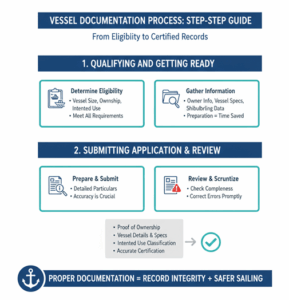
Qualifying and getting ready
The first step is to confirm eligibility. Some vessels not eligible. Eligibility depends on vessel size, ownership structure, and intended use. Requirements must be met with the acceptance of the owners before proceeding
Assemble all relevant information. This could be owner info, vessel sizes or shipbuilding data. Well preparation saves time later.
Submitting application and information
When the applicant’s eligibility is established, the application is prepared. This step refers to the submission of detailed vessel and ownership particulars. It is at this stage, accuracy is important.
Perusal of the submitted information is for completeness and consistency. Mistakes or neglects can postpone processing. Submit after careful review to improve outcome
- Proof of ownership.
- Ship details and specs.
- Classification of vessel’s intended use.
- Accurate Certification.
Every element reinforces record integrity.
Vessel Documentation as Compared with State Registration
Unlike state registration, understanding the steps for vessel documentation is much easier. While both are identification they are not same in scope.
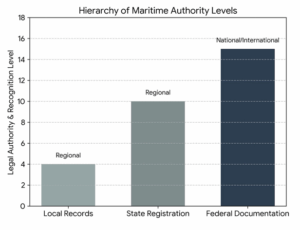
- Federal Documentation is legally superior (Level 15); it has standardized national recognition that far exceeds the scope of state or local documentation.
Instruction on Completing Documentation Steps
To complete the steps for vessel documentation, be very careful. A good owner will first check all information. Harmonized data reduces processing issues.
Grasping timelines is crucial too. Processing your application could take time Planning ahead can help avoid operational delays
Owners need to keep copies of any/all submittals. Documentation records help strengthen future updates, renewals, or the transaction. Keeping records well organized pays off in the long run. Communication is another key factor. Incomplete responses often result in delays.
Best practices that are useful include
- Before starting, check eligibility.
- Check the submitted information 2 times.
- Plan for processing time.
- Keep copies of documents records.
The practices enhance efficiency and accuracy.
The Importance of Following These Steps
The process of vessel documentation creates a clear visit path to federal vessel recognition. Every action helps in maintaining accurate ownership records and legal compliance while getting national recognition.
Documentations can ease transactions and provide confidence to vessel owners. Vessel Registrar LLC The records created by users are accessible and verifiable by the authorities. It fosters transparency and trust in the maritime system.
If shipowners follow the steps for vessel documentation carefully, they can be certain that they will see it through. Documentation is more than just a necessity. It is the foundation of ownership and responsible recognition of vessels.
