



The History of Boat Registration US shows the nation’s long associations with sea trade, defense, and recreation. Boat registration has been essential in identifying the owners of wooden trading vessels at colonial ports and varies from yachts to commercial fleets. The early American legislators realized that writing vessels were necessary for trade and security. As time passed, these regulations became a system regulated by the federal government, the United States Coast Guard.
Today’s vessel documentation system may seem administrative on the surface, but it is grounded in a long history of legal developments. The History of Boat Registration US shows how documentation has evolved to safeguard ownership rights, facilitate maritime trade, and support national security over time.
The article looks at how registration systems came into being, how they changed over time and what is their function today. Through analysis of the past, we see how modern vessels are structured and useful.
First Boat Registration in America
Boat documentation started in America in the late 1700s, with origins in the 1780s. After independence, Congress understood the importance of regulating shipping trade. The young nation depended on shipping it as their bread and butter.
In 1790, the first federal registration act provided ship documentation procedures. Under this law, foreign trading ships had to register under U.S. law. Registration confirms a person’s nationality and protects their commercial interests.
The system additionally denied foreign vessels access to the domestic trade. It ensured that only registered American ships carried freight between U.S. ports. This was cal protection.
| Year | Milestone | Purpose | Authority |
|---|---|---|---|
| 1790 | First Registration Act | Establish vessel nationality | U.S. Congress |
| 1792 | Enrollment and Licensing Act | Regulate domestic trade | Federal Government |
| 1840s | Expansion of Port Records | Improve tracking | Customs Offices |
| 1915 | Coast Guard Formation | Centralize enforcement | U.S. Coast Guard |
| 1980s | Modern Documentation Reform | Digital record integration | USCG |
Initially, port customs collectors used handwritten registration books. The names, tonnage, and ownership of vessels. Although rudimentary by today’s standards, they established the federal supervision of radio.
Evolution through the nineteenth and twentieth centuries
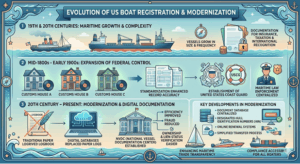
With the increase in maritime trade grew the complexity of the registration systems. Advancements in steam power and industrial shipping made vessels big in size and frequency. Documentation became important for insurance, taxation and international recognition.
Expansion of Federal Control
By the mid-1800s, federal authorities realized that they needed better coordination. Each customs house kept records on their own. Standardization efforts enhanced the accuracy of records.
The year 1915 marked the establishment of the USGC. Maritime law enforcement became centralized. Vessel Documentation Slowly Came Under Coast Guard Authority.
Modernization and Digital Documentation
Registration systems changed due to technological change in the 20th century. Digital databases replaced the outdated paper logs. The National Vessel Documentation Center was established by the Coast Guard.
As a result, the efficiency improved and fraud reduced. Ownership and lien status easier to verify through digital records.
Modernization Saw Several Key Developments
- Document Database Centralized.
- Designated hull identification numbers.
- Online renewal systems.
- Simplified transfer process.
Enhancing transparency in maritime trade these reforms. They made compliance for recreational boaters more accessible.
The United States has adapted boat registration throughout history. Every generation dealt with prosperity, threats, and scientific progress.
Comparative study of old and new method of registration
The transition from writing on paper to being digital shows progress. The initial registration chiefly focused on nationality. Current documentation focuses on owners, liens and compliance.
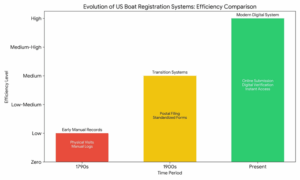
- The first adoption of the real-time ship reporting system happened in the 1790s. In those days, vessel owners were expected to make physical visits to the port offices. Over time, this process evolved into instant online submissions.
- Due to the envelope, which were susceptible to such things as physical loss, damage and fire, enhanced data integrity whereby more effective safeguards are administered, however in digital is the order of the day in such circumstances only technology that persists for an extended period and has been monitored more effectively.
- The transition from low to high illustrates shorter processing times, switching from weeks of manual verification to real-time status updates available to enforcement agencies almost instantly.
Importance of Vessel Documentation in Today’s World
The historical facts behind boat registration US show why documentation continues to matter. Federal Ownership Recognition Comes Through Vessel Documentation It supports both sea trade and global marine traffic.
Documenting a Qualifying Vessel in Federal Waters Has Advantages It allows participation in some trade routes and financing arrangement.
Boat owners usually pick documentation for these reasons
- Evidence for national registry.
- Simpler customs clearance.
- Who can get ship mortgages?
- Ownership Records Location
Documentation is vital for commercial operators. Recreational boaters may benefit while continuing their travel internationally.
The State registration systems function independently. State agencies normally register smaller vessels. The Coast Guard provides documentation options for larger and federally qualified vessels.
This system of layers indicates the history of the state The federal government began monitoring commerce and security. States governed local recreational boating activities.
The Everlasting Significance of American Vessel Documentation
An overview of boat registration US reveals a continuous evolution from simple customs logs to a more sophisticated federal documentation system. Initially utilized for protecting trade, this evolved into a broad protective framework concerning trade, safety and ownership verification.
With every period, modifications were introduced in response to economic growth and technological advancement. From the Registration Act of 1790 to today’s digital databases, vessel documentation has continually evolved to reflect national needs, a process supported by services like Vessel Registrar LLC.
Modern boaters may see registration as a paperwork regularity. Centuries of maritime law and governance lie behind that paperwork. By learning about this legacy we learn to understand and appreciate the structure set up to protect the waterways of America.
Through understanding the evolution of documentation systems, boat owners can understand their rights and obligations. The traditions of the past informs present practices and help insure the continued strength of the United States maritime regulatory scheme.
