



You should request a foreign vessel title search if you deal with a boat that is not from the U.S. Before purchasing, financing, or complying with US law, you must obtain the title history of the vessel. Foreign flag vessels are not registered under a single registry system like domestic vessels.
A proper title search will show ownership changes, recorded interest, and encumbrances. It can protect buyers and lenders against unintentional pitfalls. A title search brings clarity and certainty to foreign-registered vessel transactions.
Requesting A Foreign Vessel Title Search will help other things other than ownership. It enhances legal certainty, financial security, and compliance with regulations. Maritime transactions typically require significant investments; accurate records safeguard those investments.
This article explains the working of Foreign Vessel Title Search Request, its importance and the difference from domestic title searches and how to go about it. They can make informed, safe and good decisions when stakeholders understand the process.
Understanding a Vessel Title Search in a Foreign Country
The act of examining records kept by a foreign registry is often referred to as a foreign vessel title search. These documents provide proof of ownership, registration status and recorded interests affecting the vessel. The liability for oil and gas taxes is reviewed.
Foreign registries exhibit significant variation in their structure and accessibility. Some companies maintain centralized digital records while others maintain manual or regional records. By respecting differences, expectations are better managed along greater timelines with streamlined information.
To identify the risk involved in any piece of property. It helps to reveal a lien mortgage or title problems. If you detect these issues earlier, there will be no fights and loss of money.
A search in title provides transparency, especially from a compliance perspective. To evaluate eligibility and risk, regulators, lenders and insurers must have correct title information. Initial Vessel Documentation is the basis of transaction integrity.
| Aspect | Foreign Vessel Search | Domestic Vessel Search |
|---|---|---|
| Registry structure | Varies by country | Centralized |
| Accessibility | Limited in some cases | Generally accessible |
| Processing time | Variable | More predictable |
| Documentation format | Registry-specific | Standardized |
The working of the Title Search Request Process
Requesting a foreign vessel title search request provides registration details with reliability. Grasping the process and avoiding delays.
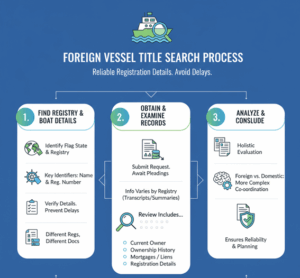
Finding registry and boat details
You need to determine which foreign registry is appropriate. Every ship is under the jurisdiction of Flag State. A boat’s name and registration number are key identifiers.
Errors and a lack of information can delay results. Good job of checking details will increase your efficiency. Different regulations require different provisions.
Obtaining and examining records
Registry pleadings were examined after request was submitted. This may include ownership history, mortgages, and other recorded interests.
Information is determined by registry practices. There are registries that give out transcripts and some summaries.
A review of a title search may consist
- Owner in possession.
- Ownership changes in the past.
- Mortgages or liens recorded.
- Details and notes of registration.
- Each component aids in the holistic evaluation.
Differences in foreign and domestic title searches affect our expectations and planning. There has to be more coordination for a foreign vessel title search request.
Search complexity comparison
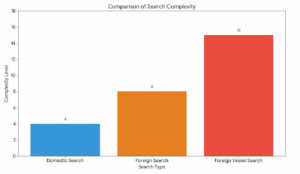
- The difficulty level in conducting foreign searches is very high compared to domestic searches because the registry system, legal system at the different place is different.
- According to maritime laws, its jurisdiction in international waters and multiple flag-state registration, foreign vessel searches, in particular, are the most complex.
- Accessing foreign data is usually hierarchical, and domestic data is centralized while record structure is standardized with easier access.
Example of a practical comparison
A centralized registry can facilitate the rapid conclusion of domestic vessel title search. (15 words) According to this, checking overseas ship registries may be required for more information as well as translation of document into English. It is essential to take your time accurately.
Advice for Submitting a Title Search Request
To successfully file a request for a title search, we must be prepared. Identification of vessels is a basis. Check the name, number and registry.
It is important to understand limitations. Certain registries do not make all information public. When we know our purpose, we won’t interpret the results incorrectly.
Be cautious while exercising timing. Searching in other countries may take longer than searching here. Requesting at an early stage helps the timing of the transaction.
Do remember to save the search results. Having records for due diligence safeguards stakeholders in negotiations or audits.
Helpful useful practices are
- “Verify the registration and identifiers of the vessel.”
- Give enough time to process.
- Take a look at the results for limitations.
- Official records should be secure.
This will lower risk and increase clarity for output.
Foreign Vessel Title Search Importance
A foreign vessel title search request is essential for confirming ownership related to foreign registered vessels. Vessel Registrar LLC This indicates how the title has changed previously.
When buyers and financiers reduce their financial and legal risks. It encourages compliance with regulators and insurers. Shipowners’ standing and obligations clarified, it states.
Knowledge and preparation and diligence give confidence while entering into foreign vessel transaction. A foreign vessel title search request is essential for proper maritime due diligence.
