



Every boat owner must understand the boat documentation and registration US requirements. Commercial fishing boat and recreational yacht registration is essential for proof of ownership and adhering to the laws. In the U.S., boat registration is required at both the state and federal levels. Although it may appear intricate, in reality, the system is organized by sea history and sea trade.
Federal documentation is administered by the United States Coast Guard and local boat registration programs are managed by individual states. Whether a vessel is classified as power-driven or sail-assisted is of fundamental importance. In respect to the size and intended use of your vessel, owners must know which process applies to you.
The guide explains how documentation works, how it differs from state registration, and its relevance in today’s world. On completion, you will learn to tackle confidently the entire process.
Essential Concepts of Boat Documentation and Registration
Boat documentation and registration US serve the same purpose but belong to different authorities. In general, smaller recreational vessels need to be state registered. Federal paperwork is applicable to qualifying ships which engage in commercial trade or bigger recreational craft.
Nationality verified by government documents. Vessels can operate within certain trades and travel around the world flying the U.S. flag. Primary focus of state registration is local identification and tax collection.
| Feature | Federal Documentation | State Registration |
|---|---|---|
| Governing Authority | U.S. Coast Guard | State Agency |
| Proof of Nationality | Yes | No |
| Vessel Size Requirement | Typically 5 net tons or more | Varies by state |
| International Use | Recognized abroad | Limited recognition |
| Preferred Ship Mortgage | Eligible | Not eligible |
Not all boats require documentation as it’s not a requirement. Nonetheless, some commercial vessels require Federal documentation. Recreational vessels may opt for documentation for benefits.
Federal paperwork developed to control oceanic commerce. State registration increased with recreation boating. Both Systems Working Alongside Each Other Today.
Eligibility should not lead to costly mistakes. Before choosing a path, owners must verify the vessel’s tonnage, intended use, and financing requirements.
Process of Federal Documentation
The federal documentation under Coast Guard requires several steps. The National Vessel Documentation Center handles applications, renewals, and transfers.
Qualifications Standards
A boat must satisfy some requirements to obtain federal documentation. The minimum weight of the vessel should be five net tons. The owner needs to be a US citizen.
Different types of documents
- Playful
- Trade along the coast
- Aquaculture
- Registry
To apply you will need proof of ownership, measurement details and citizenship. Additional endorsements may be required for commercial vessels.
Every year renewal. If you don’t renew it may expire. Through approved systems, owners can submit documentation electronically.
It incorporates the process – Boat Documentation
- Filling out forms.
- Submission of federal fees.
- Providing evidence of possession.
- Anticipating official certificate issuance.
Digital modernization made easy documentation. Many paper submissions have gone online. Processing times got better.
Documents from the federal government permit a preferred ship mortgage. This financing choice is a boon to lenders and vessel owners.
US frameworks for boat documentation and registration ensure consistent oversight. These also provide transparency for maritime transactions.
State Registration Systems and their Purpose – Boat Documentation
The state registration remains the most common form. Generally, recreational vessels below federal tonnage thresholds register with the state.
State registration entails the assignment of identification numbers found visible on the hull. Law enforcement and search and rescue operations can use these numbers.
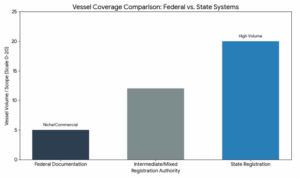
- Federal Documentation has a smaller number volume but a higher value volume than most, including for commercial fishing fleets and for ships engaged in foreign commerce or those with a fee of nationality.
- State agencies are the main collectors of registration fees and managers of renewal processes to regulate locally. They have the authority to set safety standards which differ by jurisdiction.
- Due to the coexistence of these systems the functional oversight is specialized: state registration fulfills the minimum legal requirements for recreational vessels for inland use, while federal status is required for certain commercial activities and preferred for financing yachts of high value.
Federal Documentation or State Registration: Selection Process
The choice of system is determined by the nature and use of the small vessel. Before taking further steps, owners should assess operational goals.
Owners may benefit from federal documentation
- Go abroad.
- Pursue business sponsorships.
- Need preferred ship finance by mortgage.
- Engage in coastal trading.
Opt for easier local compliance
- Commercial operators frequently possess no option. Engaging in specific maritime trades requires federal paperwork.
- Recreational owners possess adaptability. Some use documentation for status or transparency of ownership records.
- Price variations also guide choices. Federal paperwork fees are not the same as state registration fees. Not all renewal cycles are alike.
- Refer to the instructions to avoid making mistakes. If registered incorrectly financing or operations may be delayed.
- By understanding the documentation and registration system of US boats, the owners are able to take informed decisions.
Boat Documentation and Registration in the USA
The US boat documentation and registration processes have a rich history. Federal documents guarantee recognition of nationality and permission to engage in business. State registration ensures identification, local governance compliance.
Each one is useful for different purposes, and Vessel Registrar LLC can help owners understand the right option. They protect ownership rights, assist law enforcement, and support maritime commerce. Owners need to determine eligibility carefully, as vessel dimensions, intended purpose, and financing requirements help guide the decision.
If boaters understood how federal and state systems differ, they would avoid delays and confusion. Well registration facilitates smooth operation on American waters.
In the end, documentation is more than paper work. It legally identifies you and affirms your nation. Opting for the appropriate route guarantees adherence and long-term safety of your vessel.
