



It is essential for vessel owners to comprehend the rules concerning the deletion of USCG documents for their vessels. Legal documents cannot be deleted without penalty. This is the process by which a vessel is removed from the federal registry for administrative reasons upon satisfaction of specific conditions. Many owners face deletions requirements for reasons such as sale, export, destruction, or change in eligibility.
An official record at the national level is created by federal vessel documentation. When that record is deemed inaccurate or no longer applicable, it should be properly closed out. If you don’t adhere to our guidelines for deletion, it can create legal confusion, ownership disputes in the future, or compliance problems during inspections and transactions.
There is a mechanism for things to get deleted. It guarantees that only active and eligible vessels are listed in the federal registry. Proper deletion practices are in place to prevent confusion or abuse.
Article Explains USCG Documentation Deletion Rules in Detail The document discusses what deletion means, when, why and how deletion occurs, how deletion is different from other forms of documentation and what to do. Armed with the right information, vessel owners can confidently and properly deal with deletion.
USCG Documentation Deletion Regulatory Overview
The USCG documentation deletion rules govern the circumstances under which a vessel may be deleted from the federal documentation. Deletion takes the vessel’s papers away and closes its Certificate of Documentation. Once it has been deleted, it is no longer federally documented.
Deleting an item does not change that you own it. It changes the status of the documentation record. This distinction is important for legal and historical purposes. Documents are still available but are not a live boat.
Deletion rules do not hinder accuracy in law. Federal paperwork ought to mirror actual ship condition. Continuing the documentation misleads authorities and buyers if the owner has sold the ship abroad, destroyed it, or made it ineligible by obtaining a relevant certificate.
From a regulatory standpoint, removal preserves the integrity of the registry. It stops inactive or unqualified ships from showing as active federally. It safeguards the interests of enforcers, lenders and future purchasers.
| Deletion Reason | Description | Outcome |
|---|---|---|
| Sale to Foreign Owner | Vessel no longer eligible | Documentation closed |
| Vessel Destroyed | Vessel no longer exists | Record marked inactive |
| Loss of Eligibility | No longer meets requirements | Documentation deleted |
| Voluntary Request | Owner elects deletion | Documentation closed |
The deletion rules overview centers on why.
Reasons why documentation will delete
The USCG documentation deletion rules apply in certain cases. When professionals inform dog owners about specific triggers, dog owners can respond quickly and appropriately.
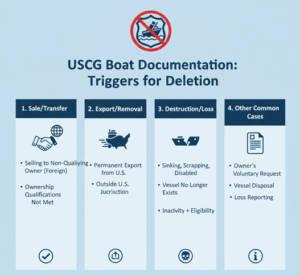
Selling eligible product, export or transfer
A frequent reason for deletion is selling to a foreign owner. Ownership qualifications are a federal requirement. We must delete an object when such conditions are no longer met.
Vessel’s permanent export from U.S. jurisdiction also triggers deletion. It ensures that authorities no longer consider the vessel documented in the United States.
Accidental sinking, destruction or loss
If the vessel is destroyed, scrapped, or permanently disabled, the owner must promptly cancel its documentation. Maintaining an entry for a vessel that does not exist creates inconsistencies.
In some circumstances, extended inactivity coupled with ineligibility might also lead to removal. The status of the vessel determines each situation.
Some common deletion instances are
- For sale to a non-qualifying owner.
- Permanent shipment beyond U.S. waters.
- Disposal of ship.
- Owner request wanted.
Deleting Documentation as Compared to Other Status Changes
Definition of rule for USCG documentation deletion becomes clearer by comparison to other documentation actions like renewal or reinstatement.
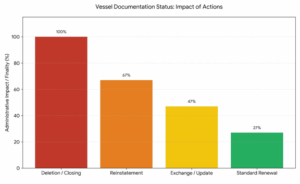
- Deletion is the most final measure when impact is at full 100 percent. It closes the federal record permanently and removes the vessel from the active database of the National Vessel Documentation Center (NVDC). It generally happens due to a sale to a foreign citizen or by the owner’s request.
- To restore the status of the documentation after the grace period, reinstatement is compulsory. The verification process is more extensive than a simple renewal to bring the vessel back into compliance. Therefore, it has a high administrative impact (67%).
- Routine Maintenance (Renewal): Renewal is used to maintain the record in active status. The disruption impact for this measure is 27%, meaning that it can never cause a vessel to lose its documented status.
How to Implement Deletion Rules in Practice
To be aware of USCG documentation deletion rules. An owner should determine that his vessel is still eligible for documentation. Evaluating early on prevents delays and non-compliance.
Reasons to delete must have supporting documentation. Having clear records is helpful to confirm eligibility changes. Well-informed data speeds up transactions.
Time is everything. The owner should submit a removal request promptly after such an event. Delays could lead to confusion or liability issues.
The owners must also keep deletion confirmation. Officials properly closed the federal documentation, and this record proves it. During audits and transactions it can be useful.
Here are some useful the best practices for USCG Documentation Deletion Rules
- Recognize deletion triggers sooner.
- Back up information with accuracy.
- File removal requests quickly.
- Keep delete verification safe.
These steps help to stay compliant.
The Importance of USCG Documentation Deletion Rules
The rules for deletion of USCG documentation are key to maintain credible and authentic federal vessel records. They make sure that documentation shows true ownership, eligibility and vessel status.
Vessel owners who adhere to deletion rules would be legally sound in the future. Vessel Registrar LLC protects the integrity of the registry for regulators. It helps buyers and lending agencies with clarity and trust in documents.
Owners can manage the documentation with the right knowledge of when to delete and how it works. Rules for deletion of USCG documentation are not hurdles They help ensure transparency and accountability in the maritime system.
