



The legal framework that regulates how recreational vessels navigate the waters of the United States. Rules and regulations are designed to keep our resources and citizens safe, the environment secure, and ensure uniformity throughout the state and waterways. Recreational boaters out for a good time must also comply with federal rules in order to boat legally and responsibly.
Federal regulations apply across the nation, unlike states. It includes vessel equipment, navigation rules, equipment documents and operators. A boat needs a license for driving and loading charges for using the facility.
Federal regulations confuse both new and experienced boaters alike. Yet, the majority of rules are to help and prevent. Understanding what is applicable to recreational boating makes compliance easier and builds confidence.
This article fully explains the Federal Regulations to Recreational Boating. The purpose of the proposal, core requirements, how they are more or less stringent than the states’ rules, and practical steps that boaters can take to stay in compliance. Understanding ensures a safer, enjoyable time on the water.
Federal Regulations for recreational boating
This federal regulation for recreational boating is to provide a uniform standard across navigable waters. No matter where the vessel is registered or operated within federal jurisdiction, these rules apply. State laws are supported by them but often lose out.
Safety equipment, navigation rules, pollution prevention and documentation are all covered by federal regulations for vessels. Recreational boats must comply with certain requirements depending on their size, use and area of operation.
Federal regulations are important because they create consistency. Uniformity reduces complexities when vessels move between states. Coordinated enforcement and safety oversight are also supported by them.
Federal agencies utilize such rules to track boating activity and mitigate safety issues. Compliance shields not just boat operators but also passengers, other boats, and marine conditions.
| Regulatory Area | Purpose | Applies To |
|---|---|---|
| Safety equipment | Injury prevention | Most recreational vessels |
| Navigation rules | Collision avoidance | All vessels |
| Pollution control | Environmental protection | All vessels |
| Documentation | Legal identification | Certain vessels |
Important National Standards for Recreational Boats
Federal regulations for recreational boating contain several basic requirements that apply to most recreational vessels. When boaters are knowledgeable of these rules, they can operate their boats in a legal and safe manner.
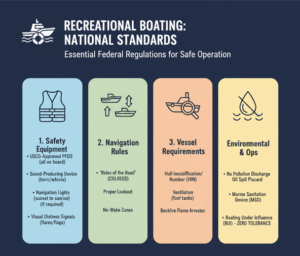
Safety equipment and ship standards
Recreational vessels must contain certain safety equipment according to federal law. Different vessels have different operating conditions. Equipment setting ensures readiness for emergencies.
Common equipment requirements include a personal flotation device sound producing device and navigation light. The items help to see, communicate, and survive.
Rules for navigation and operation
The navigation rules dictate how vessels interact. right decision rules and behaviors under different conditions Constant navigation rules can help reduce collision.
Operators must understand and follow these rules at all times. Non-compliance can cause accidents and result in enforcement action.
Fundamental need elements regulate(mandates)
- Endorsed safety gear.
- Following rules of navigation
- Identify the right boat.
- Stay within pollution limits
- All the elements help to ensure safety.
Federal Guidelines in Contrast to State Boating Laws
Recreational boating regulations made by the federal government differ from those made by a state in capacity and authority. Having knowledge of those differences news boaters.
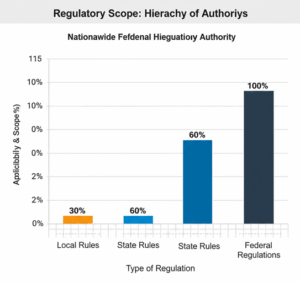
- Federal Regulations (100%) have the broadest scope of all standards. They are universal in that they set standards applicable regardless of the state where the vessel or aircraft happens to be. These are safety, navigation, and equipment standards.
- State Level Specificity. State Rules (60%) mainly concern local issues, for example specific requirements for safety education or the local registration fee or environmental protections to suit the state’s geography.
- Local Rules (30%): These refer to the narrowest scope usually related to specific waterway rules, noise regulations, or speed restrictions only within a given city or harbor.
Expert Tips for Leisure Boat Users
Knowing federal regulations to recreational boating starts with awareness. Before operating a boat, people must know federal rules. An understanding eliminates uncertainty and risk.
Vessel checks are an achievable compliance step. Tools must be checked on a regular basis. Safety is supported by preventive maintenance.
Maintaining Records is Important Documentation, identification numbers, and registration documents should be up-to-date and readily accessible. Organized records assist compliance checks.
Stay aware as a boater Policy changes can occur to mitigate safety or environmental problems. Keeping current keeps you compliant.
Effective preferred method entails
- Check federal boating requirements regularly.
- Check safety gear prior to trips.
- Keep precise vessel details.
- Check for changes in the boating rules.
These practices encourage responsible boating.
Importance of Federal Regulations for Boaters
The Federal Regulations to Recreational Boating provide a reliable framework for safety, navigation, and environmental integrity across the waters of the United States. They make sure that recreation boating is easy leisure and on the up-and-up.
It encourages coordinated supervision for regulators. Vessel Registrar LLC encourages sustainability and mutual responsibility for water bodies.
Barriers to enjoyment, federal regulations to recreational boating support a safe and rewarding experience on the water.
